
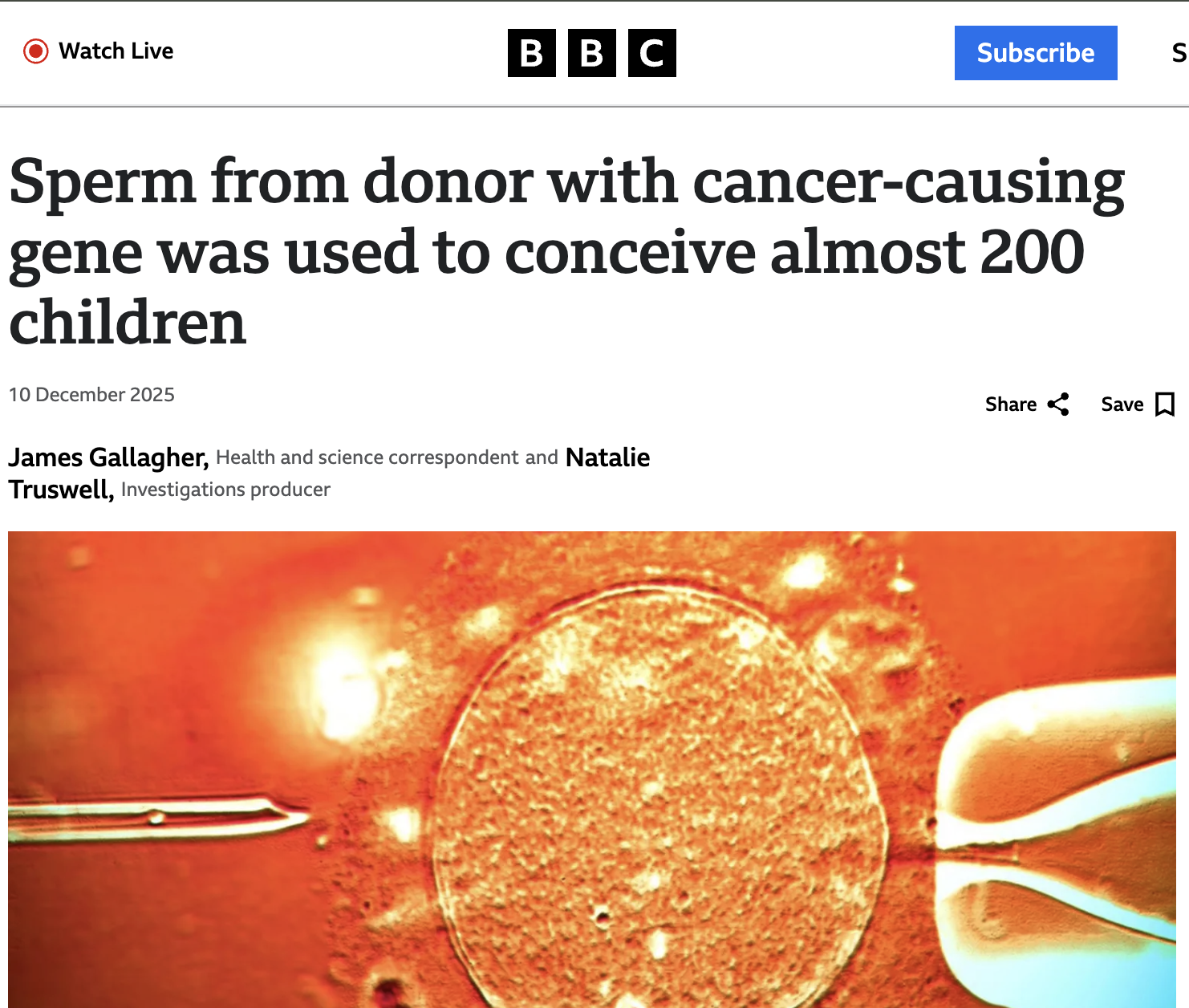
On December 10, 2025, the BBC published an important investigative piece about the use of sperm from a donor with a genetic mutation that causes serious cancer risk to conceive at least 197 children across Europe. It’s a story about real institutional failure, real consequences, and real families affected.
We’ve been thinking about what this story tells us about how the media covers donor conception and what authentic coverage could actually look like.
What the BBC Did Well
First, we want to acknowledge the strengths. This is legitimate accountability journalism. The reporters:
- Named specific failures. Denmark’s European Sperm Bank breached national limits in Belgium (38 families instead of 6). While Belgium’s six-family limit went into effect in 2007, the national database to monitor this limit across different clinics only became operational on January 1, 2024. Before 2024, clinics tracked their own records, which allowed for breaches of the limit.
- Followed the money. The piece clearly explains why these international sperm banks operate the way they do: profit. They sell to multiple countries specifically because that’s how they make money.
- Used respectful language. No sensationalism in the terminology itself, though we could do without the verb “fathered” in the first sentence. ‘Fathered’ can have a connotation that the person actively caused a pregnancy resulting in the birth of a child. In the case of gamete donation, the role of the donor is passive.
What Bothered Us
Imagine you’re a donor-conceived adult. You discovered years ago not only that you are donor-conceived, but that you’re one of dozens of genetic half-siblings. You’ve had to process that shock, make decisions about trying to find those siblings, and figure out what this all means.
Now imagine something else: you have a hereditary health condition. Something genetic that runs through your donor’s family. Cancer, heart disease, autoimmune condition—something that connects you to these genetic half-siblings in a profound and difficult way.
This is not a hypothetical. These stories exist, right now. People are living with exactly the complexity that the BBC article was documenting.
The BBC could have talked to them.
Instead, the article focuses on medical experts, institutional voices, and policy discussions. Donor-conceived people themselves—the actual experts on what it’s like to live in this situation—don’t appear.
This isn’t just a medical story or a regulatory story. It’s a story about what it means to discover, as an adult or child, that your genetic connections are more extensive and more medically significant than you ever imagined.
The Journalists Could Have Done This
We want to be clear: This isn’t a criticism of investigative journalism or accountability reporting. The BBC’s work documenting institutional failure is legitimate and important. But investigative journalism can hold institutions accountable AND center the voices of people affected by those institutions’ failures.
The reporters could have reached out to donor-conceived support networks and asked: “Do you know people who are part of large genetic sibling cohorts and/or who have discovered genetic health conditions tied to their donor? Would they be willing to speak about their experience?”
Including 2-3 quotes from donor-conceived people about what this experience is like would have let those voices articulate the potential for compound shock, identity implications, and psychological realities for the nearly 200 children.
Those voices exist. The journalists could have found them. This is an invitation to do better.
Parts of Me exists to expand authentic representation of donor-conceived people across arts, media, and culture.
If you’re a journalist working on a donor conception story and want to talk about sources and authentic coverage, reach out to us.
