
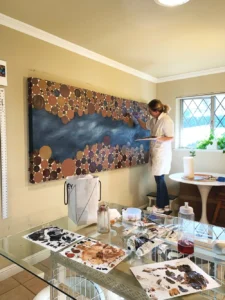
Whitney Williamson Lofrano spent nearly twenty years as an art director for international advertising agencies, working with clients including Lucasfilm, Barclays Global Investors, and Sutter Health. After her second child was born, she stepped away from corporate work to raise her children and found that the distance from any sort of creative practice became a crisis in itself.
When her maternal grandmother Shiela saw her granddaughter drifting toward depression, she handed Whitney French press paper she’d been saving since the 1970s. “Just sit at the kitchen table with watercolors,” Shiela told her. “Pick up a brush every day if you can.”
Shiela came from a line of women ranchers in Reno, Nevada: a female-owned and operated operation stretching back 150 years, rare for its time and rarer still for how long it held. These women were practical, capable, and, unexpectedly, devoted to art. It was something close to sacred. For Whitney, that inheritance – art as medicine, art as divine, art as truth – is the foundation everything else is built on.
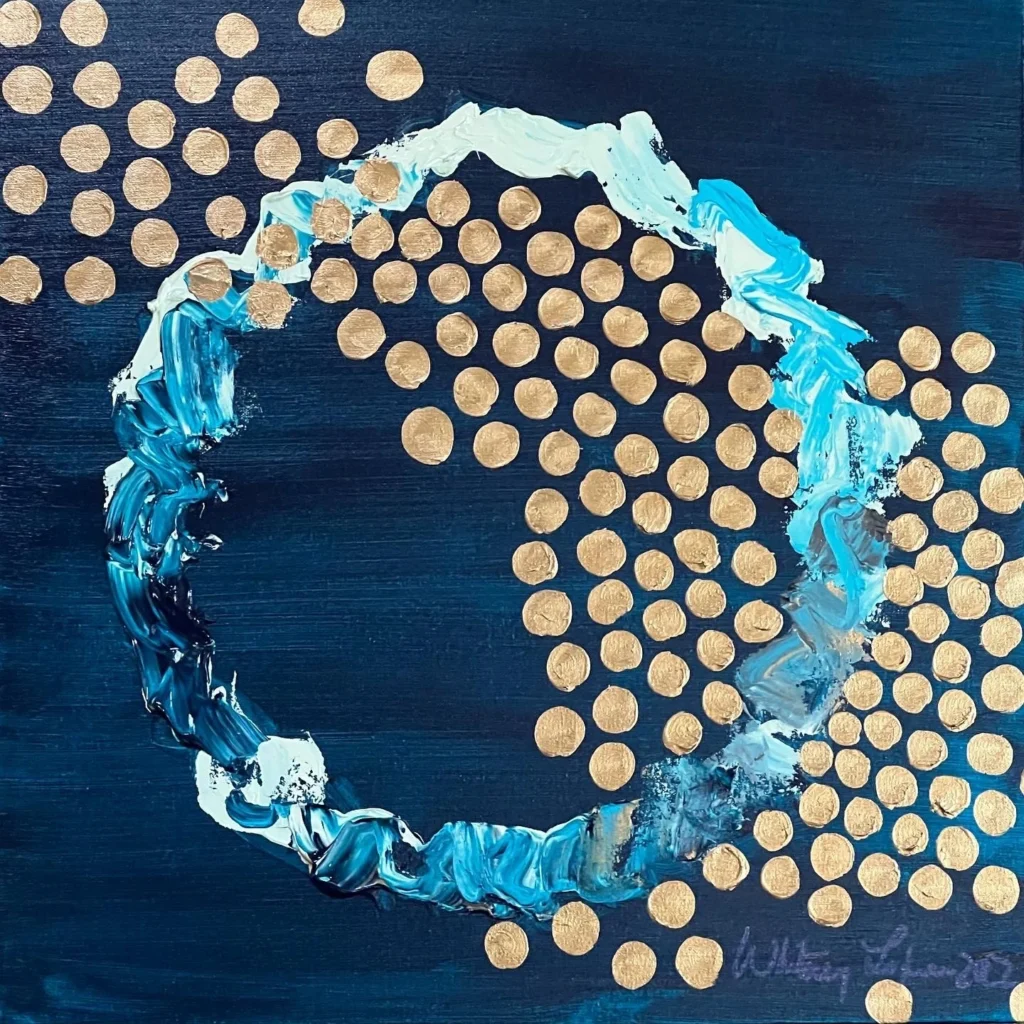
“Don’t Use Black Paint (out of a tube)”
I can pretty much tell you that anything I learned about color science came from my Gram. She would teach me and all her other students how to mix red, yellow and blue together to make our palette. She would always tell me that black from a tube would kill anything it touched. We could mix black only from primary colors. It was a yucky muddy black. When I was charged with cleaning out her art studio, I found a used tube of black oil paint with her name on it. I asked her about it on the phone to memory care. She said, “It’s fun to break the rules sometimes” with a giggle.
Getting Sober, Getting Specific
Her first major show, Full Circle (Tim Collom Gallery, 2017), was about getting sober, meeting herself again, and recognizing the people and situations that had accumulated around her drinking. Her second show, Round Two (Tim Collom Gallery, 2018), turned outward. It was about living in a world that felt cleaved in half – politically, socially, personally – and asking what one person could possibly do with that. How do you hold your ground and still reach across? What Goes Around (Tim Collom Gallery, 2020) was about carving out a self while the people around you are in crisis.
“I feel like art is the most real representation of the internal world. I feel like, when I’m in flow, I’m in reality. I feel like I am able to tell truth at truth’s deepest level. And if that can help one person on the other side of that painting, on the other side of that writing, on the other side of anything, that is humanity.”
Whitney Williamson Lofrano
What makes Whitney’s work land is a combination you don’t often see: large-scale abstracts – circles, dots, layered pigment – paired with short, direct written statements that tell you exactly what she was thinking when she made them. Art school teaches you to leave space for the viewer. Whitney closes that space on purpose. She gives you her specific truth, and somehow that specificity makes room for everyone else’s feelings too.
A Language Borrowed from the Earth
Just before the pandemic, Whitney and her daughter traveled to Northern Australia, where they were welcomed by an Indigenous artist who took them in and showed them where to pull pigments from the earth and how to build palettes from native plants. He taught them a traditional dotting technique used within Aboriginal communities to tell stories of heritage and ancestry, a visual language in which dots can represent people, footsteps, rivers, stars, and beyond.
After she thanked him for sharing the technique at the end of the visit, the artist looked Whitney in the eyes.
“You’ll need it one day.”
She didn’t know what to make of it. She wrote down her notes, filed them away, and flew home.
The Call That Changed Everything
In June 2020, Whitney was driving her dog home from the groomer when her mother called and told her to pull over. Her mother had been crying. She told Whitney she was sorry. Then she said, “Your father, he’s not your father.”
The secret had been kept for 42 years, and what finally broke it open was her oldest half sister’s cancer diagnosis. When her father’s side of the family began discussing testing for the BRCA gene, the question of family medical history became urgent. Her mother didn’t want a stranger from the lab to deliver the news, so she called.
In the days that followed, Whitney remembered something else. Years earlier, she and a group of friends had taken AncestryDNA tests for a dinner party game. A stranger had messaged her to ask whether anyone in her family might have donated sperm in the Berkeley area in the late 1970s. Every man in her family had lived in Berkeley at that time. She’d let the message sit, and then she forgot about the account entirely.
He’s Not Your Father
Isolated in the pandemic, Whitney went to her studio. She painted and cried. Then she painted and cried some more. And she remembered what the artist in Australia had told her: You’ll need it one day.
Using the same dotting tradition she’d been taught – dots as carriers of lineage, of connection, of story – she began making the work that would become He’s Not Your Father, a show of 32 paintings that opened at The Witching Post in Sacramento in 2022. Each painting is paired with her thoughts: “Can love live where the truth is hidden?” “Who else is out there in the void of possibility?” “We can’t live in self-pity and gratitude at the same time.”
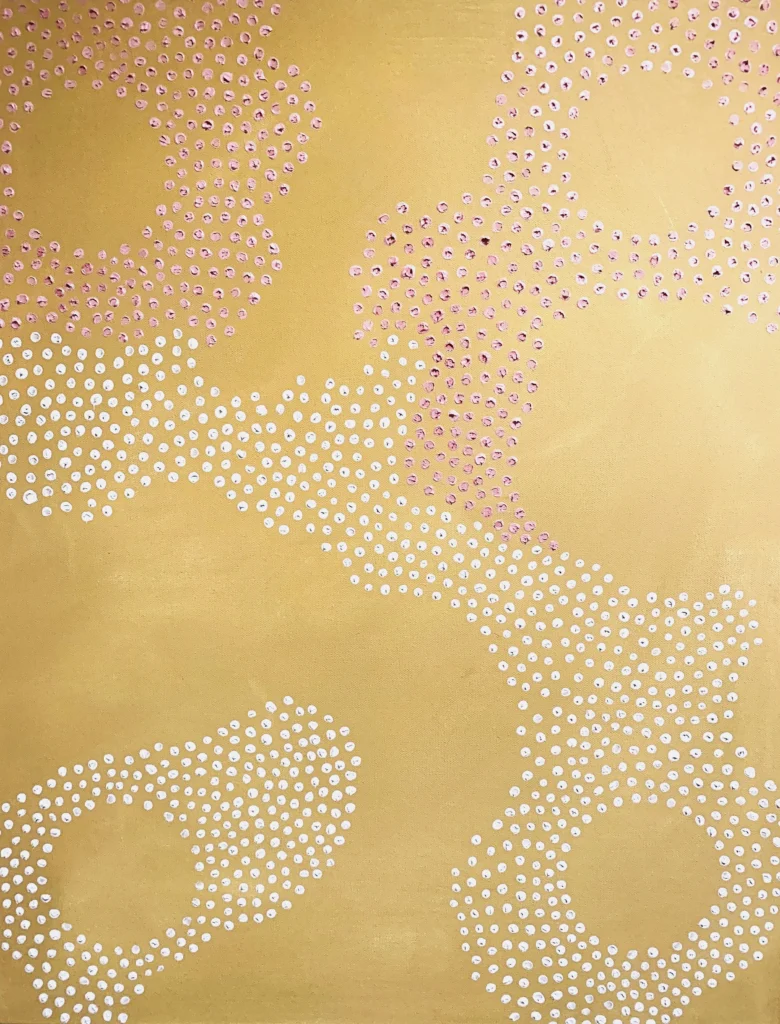
“Ignorance is Bliss”
It seems I was living in bliss much longer than the average child of donation. My new half brother knew as a child. He didn’t seem better for knowing sooner. He just had the strange knowledge longer. The Doner Sibling Registry was filled with palpable desperation of others looking for unknown family. Because I was born to a loving Spiritual Father, my searching doesn’t feel necessary, only interesting.
Finding the Room
When Good Morning Sacramento promoted the show, the segment ended with the newscaster, live on air, saying, “So if you’re Whitney’s dad, come on down.“ Whitney was taken aback. She hadn’t said she was looking. The show wasn’t a search. It was a reckoning, and then a kind of peace.
What actually happened when the show opened was quieter and more important. People came up to Whitney and said: “I found out on 23andMe.” “I found out on Ancestry.” “I’ve never heard anyone talk about this before.” The show became an unexpected gathering place for people who hadn’t known there was a community waiting for them. Whitney started pointing people toward books, resources, and each other. The art had done what art is supposed to do.
You can learn more about Whitney and check out her art at www.whitneylofrano.com and follow her on Instagram at @cyberwhit.
Parts of Me exists to expand authentic representation of donor-conceived people across arts, media, and culture.
- Browse our DCP Stories Collection to discover existing authentic donor conceived representation
- Meet Donor-Conceived Creators whose works are shifting narratives
- Access our Media Guidance if you’re creating or reporting on donor conception
- Learn about Creator Fellowships (launching Year 2)
