
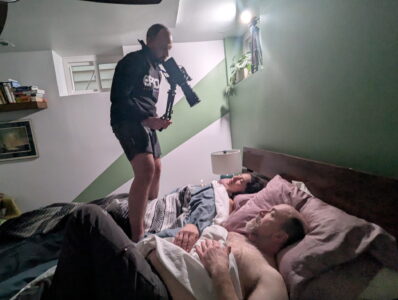
A.D. Burnett grew up feeling that something wasn’t quite right. Not wrong exactly; just off. A quiet dissonance he couldn’t name. Then, in his early thirties, he overheard a hushed conversation at his aunt’s house over the holidays and discovered he was donor-conceived. His father was not his biological father. The discovery brought what felt like clarity. It answered a question he hadn’t known how to ask. However, it’s more complicated now. That initial feeling of revelation, he says, has dissipated. What feels clearer to him now is that his childhood uneasiness at least had a shape.
The Inheritance
In A.D.’s family, Friday nights were family movie nights. His earliest memory is seeing Die Hard in the theater when he was four. His dad took him to see Pulp Fiction when he was ten, and A.D. liked it so much he took his mother back, which required some negotiation at the ticket booth. By eleven, The Shining was his favorite movie.
Sunday mornings, A.D. would wake up early to watch another movie with his mother — something indie or foreign and quieter. The pattern was clear early: this was a child who was going to spend his life in film, and the people taking him to the movies were a big part of the reason why.
That love of cinema — and an appetite for stories that don’t look away — came from his family. The inheritance is real, and the discovery that his father wasn’t his biological parent hasn’t changed how he holds it. “I still mostly think of it as being one of his biggest contributions to my development,” he says.
“The deepest purpose of art is to help us understand ourselves. When donor conceived stories become more visible, there will be greater opportunity for us to find refuge in the self-discovery and acceptance that art provides.”
                                                            - A.D. Burnett
The Human Heart
A.D. is drawn to what John Carpenter calls “internal horror”: not the monsters lurking in the darkness, but those living in the human heart. The monsters we fear, he believes, are often reflections of our own destructive, violent, and selfish impulses projected outward onto something we can call other.
His films are controlled and precise, interested in the machinery of harm rather than its spectacle. They are dark, but not nihilistic or cold-hearted. What makes them difficult to watch from a distance is their specificity. The horror isn’t in a haunted house or a dark alley. It’s in places you recognize, in situations that feel uncomfortably familiar.
“My work is typically quite divisive,” he says, without apology. His films don’t offer the catharsis of conventional horror. There’s no evil to defeat, no survivor to root for, no release. Instead, they offer something harder to shake, the feeling that you’ve seen this before. That you know these people.
In Desperate? Defeated? Depressed? [content warning: suicide, sexual content, manipulation], a man calls a suicide hotline, and the operator who answers is not what he appears to be. The horror of the film lies not only in what the operator does but also in how it is concealed within an act of service. Communication is Key approaches the same territory. A husband takes up all the space in a marriage, leaving no room for his wife. She is not the monster; she is what the monster made. Taken together, the films return to a similar terrain: men who use intimacy — a hotline call, marriage — as instruments of control.
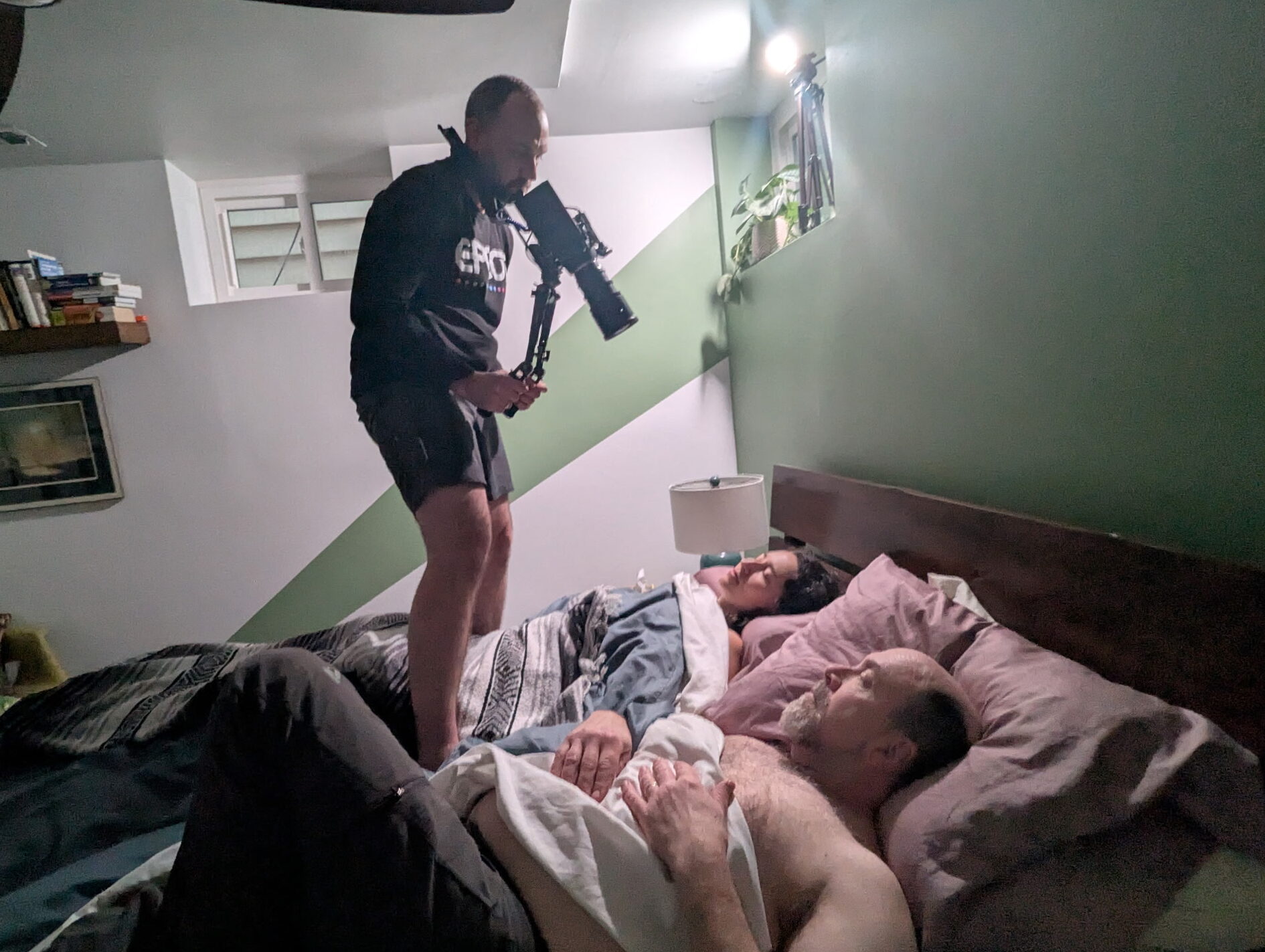
The gap between what people show and what sits beneath it runs through everything A.D. makes. That’s where he works, making what is hidden inside us harder to ignore.
You can watch A.D.’s films on YouTube.
Parts of Me exists to expand authentic representation of donor-conceived people across arts, media, and culture.
- Browse our DCP Stories Collection to discover existing authentic donor conceived representation
- Meet Donor-Conceived Creators whose works are shifting narratives
- Access our Media Guidance if you’re creating or reporting on donor conception
- Learn about Creator Fellowships (launching Year 2)
