
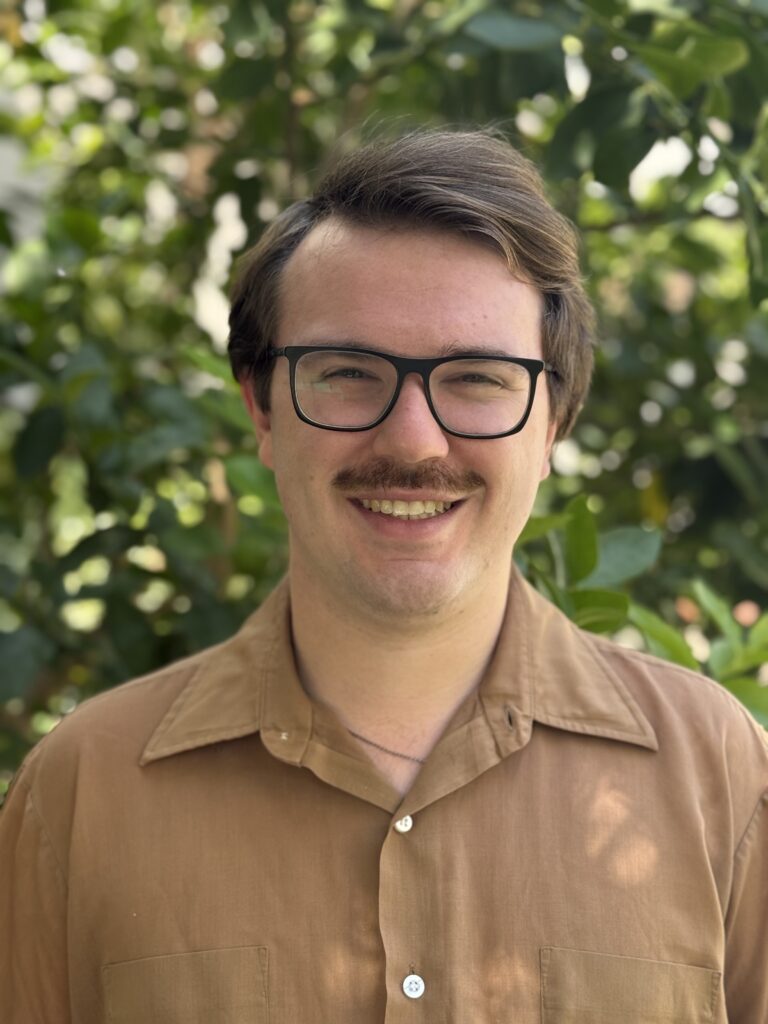
Asher de Forest was born in 1998 and grew up in Kirkland, Washington. Theater has been part of his life since childhood through acting classes, camps, and community productions. He was raised by two parents he describes as deeply creative, in a household full of stories and music. At Macalester College, he declared both a theater major and an English creative-writing major without noticing, for two years, that there was a form built for exactly their intersection. In the back half of his sophomore year, he took his first playwriting class. “I kind of didn’t look back,” he says.
Four People in a Car
Asher wanted to write a comedy about grief. “I thought that the intersection of those two things felt interesting to me,” he says. Once he had his founding idea, he built outward from a deliberate list of things he wanted the play to hold: being donor-conceived, a young bisexual protagonist, Judaism and Jewish siblings, and deep friendship. The play’s road-trip form came from a short trip to the Oregon coast that he, his mother, and his brother had taken not long before he started writing. An assignment to write a one-act, which he misunderstood as simply meaning no intermission, turned into a script long enough that his professor told him he’d written a full-length play by accident.
I’m Going to Go Back There Someday follows Garry, a 26-year-old bisexual Jewish man whose father has recently died, on a road trip to meet his sperm donor for the first time, alongside his teenage sister Rachel, his girlfriend Joni, and his ex-boyfriend-turned-best-friend Mohammed. Each of them is carrying something alongside Garry’s grief: Rachel navigating the same loss from a different age and vantage point, Joni managing a decade-old loss that Garry’s grief keeps reopening, Mohammed — who considered Garry’s father a father figure of his own — living with an ongoing, unresolved rupture with his own parents since coming out.

A short piece Asher had written for a class exercise, about three men inside a whale, became a graphic novel Mohammed is writing that comes alive onstage alongside the road trip: Pinocchio, the biblical Jonah, and the mariner from a Kipling story, each modeling a different, unresolved way of carrying grief. Puppet, like Garry, searches without any guarantee of an answer. Prophet, like Rachel, insists everything will be fine until the reckoning can’t be deferred any longer. Mariner tries to engineer his way out of the whale the way Joni organizes and schedules her way through loss, certain enough ingenuity will solve what’s actually unsolvable.
Not an Experience I Can Draw From
The play’s donor plot is personal in origin but not autobiographical in shape. Asher’s parents told him he was donor-conceived around age ten. Growing up, he knew a few other donor-conceived kids, mostly friends with two moms or a single mom by choice, but it wasn’t something he thought about much. He’s said the timing of his father’s death when he was 18 happened to coincide with an interest in reaching out to the sperm bank that contributed his own conception, mostly, he says, wanting to be able to thank the donor for his being alive. That correspondence didn’t lead anywhere.
The meeting his protagonist Garry has with his donor is invented outright: “that is not an experience I can actually draw from.” What he did draw on, he says, was the writer’s usual tool — the “what-if” — filtered through a character with his own personality, making his own choices in the moment. As it turns out, the meeting the play builds toward ends up being just a small part of the larger narrative.
Asher calls his mother one of his earliest trusted editors. Their conversations were, in his words, “about the play, but also about our lives,” made easier, he thinks, by her ability to recognize both the connections and the distinctions clearly. That distinction becomes harder to maintain once the play reaches an audience that doesn’t share her vantage point. After a performance he directed during his senior year as his directing thesis, a cast member thanked his mother for letting the production tell her family’s story. She laughed it off afterward, telling Asher she, of all people, could recognize it wasn’t their story.
Donor conception resurfaces elsewhere in his work, more directly. Father Abraham, currently a first draft, follows the sperm donor from Someday and the son he raised himself. The rest of his catalog shows his instinct for taking mythical or scriptural figures (a stranded alien in a play whose title means “soul” in Hebrew, the first and second women in Genesis, Noah’s flood) and weaving them into contemporary, often comic and queer, narratives.
I desire to make theatre because theatre haunts me. I intend to continue experimenting with style and form as a theatre-maker because hauntings from my own life — some of which I am quite open about and some of which I choose to keep private — form who I am.
                                                            - Asher de Forest
What Got Him In
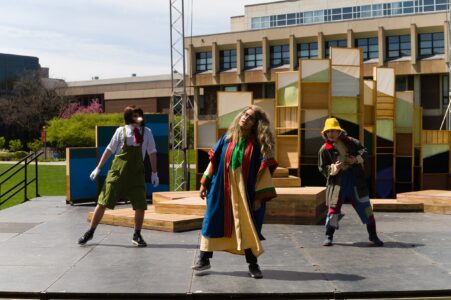
The play has had quite a life: a staged reading of its first act in college, a full production as his 2021 directing thesis (rehearsed partly over Zoom with a cast scattered across time zones and staged outdoors in Minnesota under shifting pandemic guidance), a 2022 semifinal placement in Shattered Globe Theatre’s Global Playwright Series, and a 2024 staged-reading production in Charlottesville that Asher watched, for the first time, as an audience member rather than its director, someone else’s staging of a play he’d spent years inside of.
Since graduating from Macalester with honors in directing in 2021, Asher apprenticed for a year at the Playwrights’ Center starting in 2023, was a National Playwrights Conference semifinalist and an Epiphanies New Works Festival shortlisted writer in 2024, received the Stage Spirit: Dini Ostrov Award in Playwriting in 2026, and recently completed his first year of an MFA in Playwriting at UCLA, where Someday, the play that started as a misunderstood homework assignment, was one of the works that got him in.
Parts of Me exists to expand authentic representation of donor-conceived people across arts, media, and culture.
- Browse our DCP Stories Collection to discover existing authentic donor conceived representation
- Meet Donor-Conceived Creators whose works are shifting narratives
- Access our Media Guidance if you’re creating or reporting on donor conception
- Learn about Creator Fellowships (launching Year 2)
