
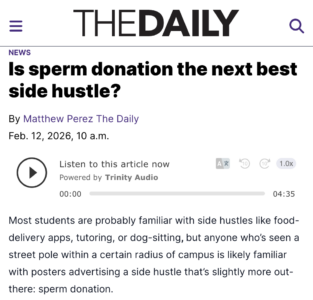
In a blog post, Seattle Sperm Bank reflected on pushback over sharing an article that framed sperm donation as a “side hustle.” They acknowledged that the donor conception community responded with concern, frustration, and pain. They named the gap between media framing and lived experience. They said language matters.
They’re right, but there’s more to unpack here.
What They Did Well
The piece does something the fertility industry doesn’t always do: it listens. It doesn’t get defensive. It names donor-conceived people as stakeholders with legitimate perspectives, not just as outcomes of a service. The observation that “donor conception is not a moment; it is a lifelong narrative” is one we hear often. The commitment to evaluate how messages are framed and received and the acknowledgment that engagement is not just about visibility, it is about responsibility — these are exactly the kinds of institutional self-reflection this space needs more of.
That matters, and we think it’s worth saying so.
What Bothered Us
SSB writes: “We talk often about responsibility, transparency, and the evolving expectations around donor identity and connection. We have also written extensively about the importance of reframing sperm donation as a meaningful contribution to family building rather than simply a financial opportunity.”
This raises the obvious question: if you already know this, how did you end up sharing an article that slotted sperm donation alongside food delivery apps and dog-sitting as side hustles for young adults?
Sperm and egg banks recruit donors – largely young people – with messaging that most commonly leads with compensation. That’s not a secret. It’s on the posters. It’s in the campus ads.
Here’s the thing. Recruitment ads are not just reaching prospective donors. They’re reaching everyone who walks past the poster, scrolls past the social media ad, and reads the student newspaper piece. Most of those people will never donate, but they’ve absorbed a message: donation as gig work.
Recruitment language is the fertility industry’s most widespread public communication about donor conception. It reaches more people than any apology blog post. It shapes how the general public understands donation.
That’s the reckoning SSB’s reflection doesn’t quite reach. The reflection is about a headline. The problem is the ecosystem that produced it.
Who shapes the narrative around donor conception?
For many people, a recruitment ad is their first exposure to donor conception. Not a book. Not a film. Not a donor conceived person telling their own story.
This is a real ad from Xytex. Watch it. What messages would someone receive about donor conception?
Those first exposures matter. They settle into assumptions. They shape what donors think their role is, what reporters think the story is, and what the general public thinks donor conception means.
The narrative ecosystem around donor conception is shaped by many forces, and the fertility industry is one of the most powerful among them.
Parts of Me exists to expand authentic representation of donor conceived people across arts, culture, and media. That mission doesn’t stop at the boundaries of what gets published or produced. It extends to every context where donor conception is named, framed, and understood. We believe the industry plays a role in changing the narrative. The only question is whether it’s ready to be part of the solution.
Parts of Me exists to expand authentic representation of donor conceived people across arts, media, and culture.
- Browse our DCP Stories Collection to discover existing authentic donor conceived representation
- Meet Donor-Conceived Creators whose works are shifting narratives
- Access our Media Guidance if you’re creating or reporting on donor conception
- Learn about Creator Fellowships (launching Year 2)
